Sirolimus-Coated Balloon Matches Drug-Eluting Stent at One Year in Large International TRANSFORM II Trial
PR Newswire
TAMPA, Florida, Nov. 2, 2026
Late-breaking results presented at TCT 2026 show an implant-free strategy with MagicTouch Sirolimus Coated Balloon is non-inferior to everolimus-eluting in de novo coronary artery disease
TAMPA, Florida, Nov. 2, 2026 /PRNewswire/ -- Sirolimus-coated balloon (SCB) strategy was non-inferior to contemporary everolimus-eluting stents (EES) for Target Lesion Failure (TLF) at 12 months in patients with de novo coronary artery disease. These are the results of the TRANSFORM II randomised trial, presented today as a Late-Breaking Clinical Trial at TCT 2026 and accepted in The Lancet which confirm how MagicTouch Sirolimus Coated Balloon (Concept Medical) matches contemporary best in class stent.
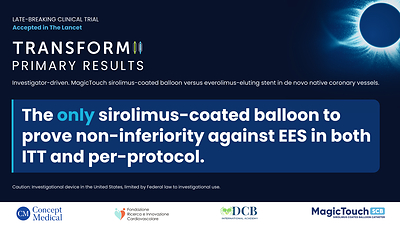
TRANSFORM II is an investigator-initiated, open-label, non-inferiority trial. It enrolled 1,842 patients in 53 centres in 11 countries across Europe, Asia and South America. Patients with a de novo native coronary lesion (vessel diameter 2.0 to 3.5 mm, lesion length ≤50 mm) were randomised 1:1 to the MagicTouch SCB (Concept Medical), with bailout stenting if needed, or to EES implantation. Randomisation took place only after successful lesion preparation, as recommended by the Drug-Coated Balloon Academic Research Consortium. The population was highly complex; nearly half of patients presented with an acute coronary syndrome, more than a third had diabetes and about a third were at high bleeding risk.
At 12 months, TLF occurred in 2.1% of patients in the SCB group and 2.4% in the EES group (hazard ratio 0.86; 95% CI 0.47–1.59). Target Lesion Failure was defined as a composite of cardiac death, target-vessel myocardial infarction and ischaemia-driven target lesion revascularisation. The risk difference of −0.40 percentage points had a one-sided upper bound of 0.78 points, well below the prespecified 1.5 point margin (P=0.004 for non-inferiority). The result was consistent in the per-protocol and device-received analyses and across prespecified subgroups.
Bailout stenting was needed in only 7.6% of patients assigned to the SCB arm, much less often than in earlier large trials where randomisation came before lesion preparation. No definite or probable lesion thrombosis occurred in the SCB group, compared with 0.2% in the EES group. Net adverse clinical events, including bleedings, were numerically lower with SCB (4.1% vs 5.3%; HR 0.77; 95% CI 0.50–1.17), and rates of death, myocardial infarction, stroke and major bleeding were low and similar in both groups.
Any target lesion revascularisation was more frequent with SCB (2.5% vs 1.1%). However, ischaemia-driven revascularisation was similar in both groups (0.9% vs 0.8%).
"TRANSFORM II shows that when a lesion is well prepared, treating it with a sirolimus-coated balloon, without leaving a permanent metal implant, gives one-year clinical outcomes comparable to a modern drug-eluting stent," said Bernardo Cortese, MD, Principal Investigator and Study Chair, Fondazione Ricerca e Innovazione Cardiovascolare, Milan. "Drug-coated balloon angioplasty should be seen as a strategy, not a simple device swap. Careful lesion preparation and readiness to stent when needed are central to its success."
The investigators noted that event rates were lower than expected, that the results apply to lesions suitable for successful preparation and do not cover severely calcified, left main, thrombotic or STEMI lesions, and that the centres taking part were experienced in drug-coated balloon PCI. Follow-up will continue to five years to find out whether avoiding a permanent implant reduces very late device-related events.
Permanent metal caging with DES has been long sought as something to avoid and the robust evidence from TRANSFORM II has provided insights proving to be a turning point in current PCI practice, which should not rely solely on stents.
The trial was sponsored by Fondazione Ricerca e Innovazione Cardiovascolare ETS, Milan, Italy, with an unrestricted research grant from Concept Medical, which had no role in the trial's design, analysis or reporting. ClinicalTrials.gov: NCT04893291.
Source: Data from TRANSFORM II, presented as a Late-Breaking Clinical Trial at the TCT USA Conference by Prof. Bernardo Cortese on November 01, 2026 and accepted in The Lancet.
MagicTouch is CE-marked. CAUTION: Investigational device in the United States, limited by Federal law to investigational use.
About Fondazione Ricerca e Innovazione Cardiovascolare
Fondazione RIC is an independent nonprofit foundation that accelerates independent investigator-driven cardiovascular research worldwide and is based in Italy and the Unites States. Founded in 2020, it gives transparent and reliable support to deliver high-quality clinical trials. With 19 clinical trials designed and conducted, 187 enrolling centers and >8000 patients enrolled, Fondazione RIC is one of the largest and most impactful cardiovascular organizations of the world. For more information, visit our website https://www.fondazioneric.org or reach out to segreteria@fondazioneric.org.
About MagicTouch SCB
The MagicTouch SCB, developed by Concept Medical Inc., utilizes proprietary Nanoluté technology to deliver sub-micron particles of sirolimus encapsulated in a biocompatible carrier, ensuring deep penetration into the vessel wall. The device has received CE Mark approval in Europe and Breakthrough Device Designation from the U.S. FDA for the treatment of small coronary vessels and in-stent restenosis. MagicTouch has also received IDE approvals for in-stent restenosis and small vessel treatment with trials ongoing for both indications.
About Concept Medical Inc.
Concept Medical Inc., headquartered in Tampa, Florida, has a global presence and is dedicated to enhancing patient care through cutting-edge research and development of drug-delivery technologies. Its proprietary platforms are designed to deliver pharmaceutical agents across vascular luminal surfaces with unparalleled precision. Concept Medical is the developer of the MagicTouch family of Sirolimus-Coated Balloons (SCB) – the world's first and most utilized SCB technology – well recognized for its versatility and efficacy in treating coronary and peripheral artery disease. The revolutionary MagicTouch and Abluminus product lines have been used to treat over a million patients globally, setting a new standard for vascular therapy.
For more information, please visit www.conceptmedical.com.

 View original content to download multimedia:https://www.prnewswire.com/news-releases/sirolimus-coated-balloon-matches-drug-eluting-stent-at-one-year-in-large-international-transform-ii-trial-302926329.html
SOURCE Concept Medical

