NEW YORK, USA, July 20, 2026 (GLOBE NEWSWIRE) -- Zion Market Research has published a new research report titled “Chemical Catalyst Market By Type (Homogeneous and Heterogeneous), By Material (Chemical Compounds, Zeolites, and Metal & Metal Oxides), By Form (Extrudate, Bead, Powder, and Others), By Application (Refining, Environmental Catalysis, Chemical Synthesis, Petrochemicals, Pharmaceuticals, and Others), and By Region - Global and Regional Industry Overview, Market Intelligence, Comprehensive Analysis, Historical Data, and Forecasts 2025 - 2034” in its research database.
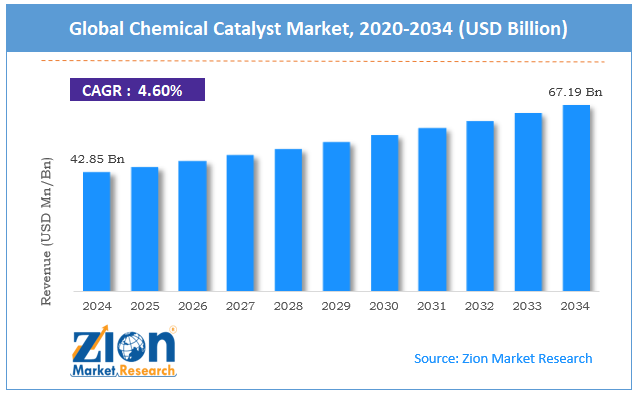
“According to the latest research study, the global chemical catalyst market size was valued at around USD 42.85 billion in 2024. The market is expected to grow at a CAGR of 4.60% and is anticipated to reach a value of USD 67.19 billion by 2034.”
Get a Free Sample PDF of this Research Report for more Insights - https://www.zionmarketresearch.com/sample/chemical-catalyst-market
Chemical Catalyst Market Overview:
A chemical catalyst refers to a specialized substance formulated to alter the rate of a chemical reaction by modifying its reaction pathway without itself undergoing any permanent chemical change or consumption in the process. These substances are vital across numerous processing industries because they lower the activation energy required for reactions, thereby enabling chemical processes to occur more rapidly and under significantly milder temperature and pressure conditions. By enhancing the efficiency of molecular transformations, catalysts play an indispensable role in improving production yields, lowering overall operational energy requirements, and enabling the synthesis of highly complex compounds across diverse sectors like petroleum refining, environmental remediation, and pharmaceutical manufacturing.
The market dynamics of this industry are characterized by an interplay of robust growth triggers, stringent operational challenges, expanding technological spaces, and environmental regulatory compliance pressures. The primary growth driver is the escalating worldwide demand for high-performance aviation fuels and sustainable energy alternatives, which require advanced catalytic pathways to maximize conversion efficiency and product purity. Conversely, the market faces significant restraints from strict international environmental regulations targeting heavy metal components like palladium and rhodium, which present profound disposal and ecological challenges if improperly managed. Nevertheless, lucrative growth opportunities are emerging through the rapid research and development of novel biocatalysts and advanced green chemical solutions designed to minimize carbon footprints. Ultimately, manufacturers face the ongoing challenge of high raw material cost volatility coupled with complex manufacturing processes needed to achieve high surface area-to-volume ratios and durability under harsh operational settings.
Report Scope:
| Report Attribute | Report Details |
| Market Size in 2024 | USD 42.85 Billion |
| Market Forecast in 2034 | USD 67.19 Billion |
| Growth Rate | CAGR of 4.60% |
| Base Year | 2024 |
| Forecast Years | 2025- 2034 |
| Key Companies Covered | INEOS Group Holdings S.A., BASF SE, W. R. Grace & Co., Arkema Group, Mitsubishi Chemical Corporation, Albemarle Corporation, Honeywell UOP, SABIC, Johnson Matthey Plc, Nouryon, Clariant AG, Haldor Topsoe A/S, Evonik Industries AG, Solvay S.A., Umicore N.V., and others. |
| Segments Covered | By Type, By Material, By Form, By Application, and By Region |
| Regions Covered | North America, Europe, Asia Pacific, Latin America, and the Middle East & Africa |
| Customization Scope | Avail customized purchase options to meet your exact research needs. |
Directly Purchase a Copy of the Report | Quick Delivery Available - https://www.zionmarketresearch.com/buynow/su/chemical-catalyst-market
Key Insights from Primary Research
- As per the analysis, the chemical catalyst market share is likely to grow at a CAGR of around 4.60% between 2025 and 2034.
- The chemical catalyst market size was worth around $42.85 billion in 2024 and is estimated to hit approximately $67.19 billion by 2034. Due to a variety of driving factors, the market is predicted to rise at a significant rate.
- The market is driven by the rapidly growing demand for efficient reaction-changing ingredients for the production of aviation fuel and sustainable jet-powering sources.
- Based on the type, the heterogeneous segment dominates with a market share of over 75% because these catalysts offer superior mechanical reusability, easy separation from reaction mixtures, and highly extensive utility in large-scale industrial petrochemical production and refining.
- Based on the material, the metal & metal oxides segment dominates with a market share of approximately 45% because these materials possess excellent electronic configurations that provide highly active surface sites necessary for complex industrial redox reactions and environmental emission controls.
- Based on the form, the bead segment dominates with a market share of around 40% due to its exceptionally high surface area-to-volume ratio, structural durability under high-pressure environments, and extensive deployment in commercial catalytic conversion and adsorption procedures.
- Based on the region, North America dominates with the highest market share of around 38% because the region benefits from massive capital investments in advanced refining infrastructure, a high concentration of tier-one catalyst producers, and intensive domestic research initiatives dedicated to novel catalyst formulations within the United States.
Chemical Catalyst Market: Dynamics
Growth Drivers
How does the surging global demand for refined aviation fuels accelerate market expansion?
The global chemical catalyst market is experiencing substantial upward momentum due to the intensifying worldwide consumption of high-grade aviation fuels, including Jet A, Jet A-1, Jet B, and Sustainable Aviation Fuel (SAF). Modern commercial aviation and defense sectors require ultra-pure, energy-dense fuels that undergo strict hydroprocessing and cracking stages during refining. Advanced chemical catalysts are indispensable in these procedures to maximize kerosene-range hydrocarbon yields while minimizing heavy residues, effectively forcing petroleum refiners to scale up their catalyst procurement strategies to meet rigorous global fuel delivery timelines.
Furthermore, the rapid paradigm shifts toward decarbonizing the aviation sector have propelled the development of sustainable aviation fuels created from biological fats, oils, and municipal waste. Transforming these complex organic feeds into drop-in aviation fuels requires specialized multi-functional catalytic networks capable of robust deoxygenation, isomerization, and hydrocracking. The rising deployment of these green energy initiatives globally serves as a foundational growth engine, ensuring sustained long-term volume consumption for high-performance catalyst systems.
Restraints
What challenges do stringent ecological regulations on heavy metal disposal pose to industry growth?
A significant restraint impacting the global marketplace is the mounting framework of international environmental safety regulations governing the storage, handling, and eventual disposal of spent chemical catalysts. Many highly effective industrial catalysts rely heavily on toxic or heavy metals, such as nickel, cobalt, rhodium, and palladium. When these systems reach the end of their functional lifespans, they are classified as hazardous industrial waste due to their potential to leach toxic metallic ions into surrounding soil and groundwater networks if mismanaged, attracting harsh legal and financial penalties for manufacturing entities.
The operational overhead required to achieve absolute compliance with these evolving regulatory standards places a considerable financial burden on chemical processors. Facilities must implement expensive specialized containment zones, pay premium rates for certified hazardous waste management services, or invest heavily in complex precious metal reclamation technologies. These escalating compliance costs and liabilities discourage smaller industrial processors from adopting high-performance metal-based catalyst systems, thereby restricting overall market volume expansion.
Opportunities
How does the evolution of advanced biocatalysis create new pathways for market development?
The aggressive research, development, and commercialization of next-generation biocatalysts represent a highly lucrative frontier for participants in the global market. Biocatalysts, which leverage natural enzymes or microbial structures, offer unprecedented levels of highly specific selectivity and can operate efficiently under ambient environmental temperatures and atmospheric pressures. This transition allows industrial chemical manufacturers to dramatically reduce the massive energy inputs conventionally required by traditional inorganic synthesis methods, aligning perfectly with modern corporate sustainability metrics.
As synthesis methodologies advance, engineered enzymes are proving highly capable of replacing traditional toxic chemical agents in sensitive settings like pharmaceutical production and fine chemical synthesis. The ability to customize these biological molecules via genetic engineering to withstand varied industrial environments creates an expansive opportunity space. Companies that position themselves early as premium providers of stable, high-throughput biocatalytic solutions stand to capture significant market share as green chemistry transitions from a niche trend into a global industrial standard.
Challenges
How do raw material cost fluctuations and complex structural engineering inhibit manufacturing workflows?
One of the most pressing challenges confronting chemical catalyst manufacturers is the extreme price volatility associated with essential raw materials, particularly noble and transition metals. The market prices of active components like platinum, palladium, ruthenium, and rare earth elements fluctuate unpredictably based on geopolitical conflicts, mining interruptions, and macroeconomic trade policies. Because these active metal components represent the primary cost driver of catalyst formulation, unexpected price surges instantly squeeze the profit margins of manufacturers and create severe supply chain instabilities for end-use processors.
Additionally, producing modern catalysts requires incredibly precise structural engineering to ensure prolonged catalytic activity, thermal stability, and mechanical resistance against poisoning or fouling. Fabricating complex architectures like customized zeolites or extrudates with precise pore distributions requires prolonged manufacturing cycles and sophisticated quality control systems. Balancing these high-tech production demands alongside volatile input costs forms a challenging landscape that requires constant operational agility and heavy research investments to sustain market competitiveness.
Browse the full “Chemical Catalyst Market By Type (Homogeneous and Heterogeneous), By Material (Chemical Compounds, Zeolites, and Metal & Metal Oxides), By Form (Extrudate, Bead, Powder, and Others), By Application (Refining, Environmental Catalysis, Chemical Synthesis, Petrochemicals, Pharmaceuticals, and Others), and By Region - Global and Regional Industry Overview, Market Intelligence, Comprehensive Analysis, Historical Data, and Forecasts 2025 - 2034” Report at https://www.zionmarketresearch.com/report/chemical-catalyst-market
Chemical Catalyst Market: Segmentation
The chemical catalyst market is segmented by type, material, form, application, and region.
Based on Type, the chemical catalyst market is divided into homogeneous and heterogeneous. The heterogeneous is the most dominant segment, which captures the vast majority of the market value due to its distinct physical phase separation from reactants, allowing for highly efficient mechanical filtration, exceptional thermal stability, and prolonged reuse across severe industrial configurations. The second most dominant segment is the homogeneous segment, which maintains a vital role in specialized fine chemical synthesis and pharmaceutical engineering because it operates in the same phase as the reactants, delivering exceptionally uniform active sites, highly predictable reaction kinetics, and superior selectivity at lower concentrations.
Based on Material, the chemical catalyst market is divided into chemical compounds, zeolites, and metal & metal oxides. The metal & metal oxides segment is the dominant one, which commands the market because transition and precious metals offer unmatched d-orbital electron configurations that facilitate diverse redox reactions, critical for large-scale automobile emission control and petrochemical conversion. The second most dominant segment is zeolites, which are highly valued for their unique, well-defined crystalline alumino-silicate microstructures that act as molecular sieves, driving high-efficiency fluid catalytic cracking and shape-selective hydrocarbon processing in modern refineries.
Based on Form, the chemical catalyst market is divided into extrudate, bead, powder, and others. The bead form is the most dominant segment, which leads the global revenue generation because its spherical layout maximizes the available active surface area while ensuring excellent pack density and minimal pressure drop across massive fixed-bed reactors. The second most dominant segment is the extrudate form, which secures a major share because its cylindrical shape provides substantial mechanical crush strength and optimized flow paths, making it highly reliable for severe hydrotreating and hydrocracking procedures under continuous operating regimes.
Regional Scope:
Why will North America continue to dominate the global market during the projection period?
North America is positioned to maintain its leading stance in the global chemical catalyst market during the forecast timeframe, primarily propelled by the extensive industrial activities and massive chemical manufacturing bases located across the United States. The region benefits from a highly mature petroleum refining sector that continuously demands advanced hydrocracking and fluid catalytic cracking catalysts to process domestic shale oil reserves efficiently. Additionally, robust financial frameworks and aggressive capital funding toward sustainable technology development allow North American manufacturers to quickly pioneer, scale, and commercialize next-generation catalytic innovations ahead of other regions.
Europe represents another highly influential regional market, supported by a dense concentration of global chemical conglomerates and strict regional environmental directives that mandate advanced environmental catalysis for industrial emissions. The Asia Pacific region is expanding at the fastest volumetric growth rate, fueled by rapid industrial expansion, massive petrochemical refinery additions in China and India, and surging domestic consumption of consumer chemicals. Meanwhile, Latin America and the Middle East & Africa show steady developmental progress, heavily anchored by investments in downstream oil processing infrastructure and expanding chemical distribution networks designed to diversify localized resource-dependent economies.
Recent Developments
- In April 2024, Clariant, a globally recognized leader in sustainable specialty chemicals, officially introduced its innovative CATOFIN 312 catalyst, utilizing cutting-edge additive manufacturing and 3D-printing technologies to optimize production efficiency.
- In November 2024, chemical researchers at Ohio State University successfully developed a revolutionary nickel-based catalyst featuring integrated aminopyridine and thionitril layers, significantly improving molecular selectivity for drug discovery pipelines.
- In December 2024, Yilkins and Shell Catalysts & Technologies publicly announced a strategic partnership aimed at commercializing an integrated version of the Shell XTL1 Process by utilizing advanced biomass torrefaction technologies.
Request For Customization on This Report as Per Your Requirements - https://www.zionmarketresearch.com/custom/9537
Chemical Catalyst Market: Competitive Landscape
The report contains qualitative and quantitative research on the global chemical catalyst market, as well as detailed insights and development strategies employed by the leading competitors.
Some of the leading players in the global chemical catalyst market include;
- INEOS Group Holdings S.A.
- BASF SE
- W. R. Grace & Co.
- Arkema Group
- Mitsubishi Chemical Corporation
- Albemarle Corporation
- Honeywell UOP
- SABIC
- Johnson Matthey Plc
- Nouryon
- Clariant AG
- Haldor Topsoe A/S
- Evonik Industries AG
- Solvay S.A.
- Umicore N.V.
What are the key trends in the Chemical Catalyst Market?
Digitalization and 3D-Printing of Tailored Catalyst Structures
A prominent trend redefining the industrial manufacturing landscape is the application of digital design tools and 3D-printing technologies to construct highly customized catalyst architectures. Traditional manufacturing techniques often limit catalysts to uniform geometries like standard beads or pellets, which can restrict flow dynamics inside large chemical reactors. By employing additive manufacturing, producers can fabricate precise geometric shapes with internal micro-channels that maximize fluid flow, reduce operational backpressure, and expose a higher number of active catalytic sites to incoming reactants, significantly boosting chemical conversion efficiency.
Strategic Transition Toward Green Catalysis and Sustainable Feedstocks
Another defining trend is the industry-wide focus on sustainable chemistry, which is prompting catalyst developers to engineer formulations compatible with renewable bio-based feedstocks and recycled plastics. As global manufacturing sectors face intense socio-political pressure to achieve net-zero carbon operations, chemical plants are actively modifying their processing systems to accept non-petroleum inputs. Catalyst manufacturers are responding by shifting away from heavy metal mixtures toward eco-friendly transition metals and robust bio-catalytic enzymes that perform efficiently at lower temperatures, reducing greenhouse gas emissions across the value chain.
The global chemical catalyst market is segmented as follows:
By Type
- Homogeneous
- Heterogeneous
By Material
- Chemical Compounds
- Zeolites
- Metal & Metal Oxides
By Form
- Extrudate
- Bead
- Powder
- Others
By Application
- Refining
- Environmental Catalysis
- Chemical Synthesis
- Petrochemicals
- Pharmaceuticals
- Others
By Region
- North America
- The U.S.
- Canada
- Europe
- France
- The UK
- Spain
- Germany
- Italy
- Rest of Europe
- Asia Pacific
- China
- Japan
- India
- Southeast Asia
- Rest of Southeast Asia
- The Middle East & Africa
- GCC
- South Africa
- Rest of the Middle East & Africa
- Latin America
- Brazil
- Argentina
- Rest of Latin America
Request Free Brochure of the Global Chemical Catalyst Market @ https://www.zionmarketresearch.com/requestbrochure/chemical-catalyst-market
Key Questions Answered in This Report:
- What is a chemical catalyst?
- Which key factors will influence the chemical catalyst market growth over 2025-2034?
- What will be the value of the chemical catalyst market during 2025-2034?
- What will be the CAGR value of the chemical catalyst market during 2025-2034?
- Which region will contribute notably towards the chemical catalyst market value?
- Which are the major players leveraging the chemical catalyst market growth?
- What can be expected from the global chemical catalyst market report?
Browse Other Related Research Reports from Zion Market Research
- Construction Anchors Market By Type (Mechanical Anchors, Screw Anchors, Expansion Anchors, Chemical Anchors, and Post-installed Anchors), By Material (Steel, Composite Materials, Plastic, Stainless Steel, and Fiberglass), By Application (Residential Construction, Infrastructure Development, Commercial Construction, and Industrial Applications), By Installation Method (Manual Installation, Pre-assembled Installation, and Power Tool Installation), and By Region - Global and Regional Industry Overview, Market Intelligence, Comprehensive Analysis, Historical Data, and Forecasts 2026 - 2034
- Can Coatings Market By Type (Two-Piece Cans, Aerosol Cans, Three-Piece Cans, and Closures), By Resin Type (Polyester, Polyurethane, Epoxy, Acrylic, and Polyvinylidene chloride (PVDC)), By Application (Food Beverages, Pharmaceuticals, Household Products, Personal Care Cosmetics, and Industrial Products), and By Region - Global and Regional Industry Overview, Market Intelligence, Comprehensive Analysis, Historical Data, and Forecasts 2026 - 2034
- Yellow Phosphorus & Derivatives Market By Form (Solid, Slurry and Liquid), By Derivative (Thermal Phosphoric Acid, Phosphorus Pentoxide, Phosphorus Trichloride and Phosphorus Sulfides), By Application (Fertilizers, Flame Retardants, Pesticides, Animal Feed Additives and Others), By End User (Agriculture, Food & Beverage, Chemicals, Pharmaceutical and Others) and By Region - Global and Regional Industry Overview, Market Intelligence, Comprehensive Analysis, Historical Data, and Forecasts 2025 - 2034
- Shade Sails Market By Material Type (Fiberglass, Plastic, Polyester, Acrylic, and Others), By Shape (Square, Triangle, Hexagon, Rectangular, and Custom), By Application (Industrial, Residential, and Commercial), and By Region - Global and Regional Industry Overview, Market Intelligence, Comprehensive Analysis, Historical Data, and Forecasts 2025 - 2034
- Metal Oxide Powder Market By Type (Silicon Dioxide, Zinc Oxide, Aluminum Oxide, Iron Oxide, Titanium Dioxide, and Others), By Application (Cosmetics & Personal Care, Energy Storage, Catalysts, Electronics & Semiconductors, Paints & Coatings, and Others), and By Region - Global and Regional Industry Overview, Market Intelligence, Comprehensive Analysis, Historical Data, and Forecasts 2025 - 2034
About Zion Market Research:
Zion Market Research is a leading market research organization offering industry expertise and scrupulous consulting services to clients for their business development. The reports and services offered by Zion Market Research are used by prestigious academic institutions, start-ups, and companies globally to measure and understand the changing international and regional business backgrounds.
Contact Us:
Zion Market Research
USA/Canada Toll Free: 1 (855) 465-4651 | Newark: 1 (302) 444-0166
India: +91 7768 006 007 | +91 7768 006 008
Email: sales@zionmarketresearch.com | Web: https://www.zionmarketresearch.com/
Follow Us on - LinkedIn | X | Facebook | Pinterest | YouTube