Adaptive supply chain model tackles fluctuating demand and emission tax pressure
KNOXVILLE, TN, December 28, 2025 /24-7PressRelease/ -- Supply chains face increasing complexity as companies struggle to balance profitability, fluctuating market demand, and carbon emission regulations. This study develops an optimal control-based supply chain model in which production rate is treated as an unknown time-dependent variable rather than a fixed value. The model integrates price- and time-sensitive demand for both retailers and consumers, linking carbon emission levels to production intensity. Using metaheuristic algorithms to solve the model, the researchers identified the equilibrium optimizer algorithm as the most effective method. Results show that adapting production dynamically can reduce emissions while improving coordination between manufacturers and retailers, offering a practical path toward sustainable and economically viable supply chain operations.
Modern supply chains operate under volatile demand influenced by seasonality, price changes, and consumer behavior, making coordination between manufacturers and retailers difficult. Meanwhile, governments globally are enforcing carbon taxes to curb greenhouse emissions, further increasing operational pressure on production systems. Most existing supply chain studies assume constant production rates, overlooking real-world fluctuations and their environmental consequences. Few models have integrated price- and time-dependent demand with emission policies, and fewer still consider production rate as an unknown control function. Due to these challenges, there is a strong need to develop models that optimize production decisions while meeting emission regulations and market uncertainty.
Researchers from The University of Burdwan, Jahangirnagar University and Tecnologico de Monterrey reported a new optimal control-based model that addresses supply chain coordination under variable demand and carbon emission tax conditions. The work, published (DOI: 10.1007/s42524-025-4110-6) in Frontiers of Engineering Management in 2025, introduces an approach where production rate is not fixed but adjusted dynamically as an unknown time-dependent function. Using metaheuristic optimization tools, the study identifies efficient strategies that align profit goals with sustainable operation.
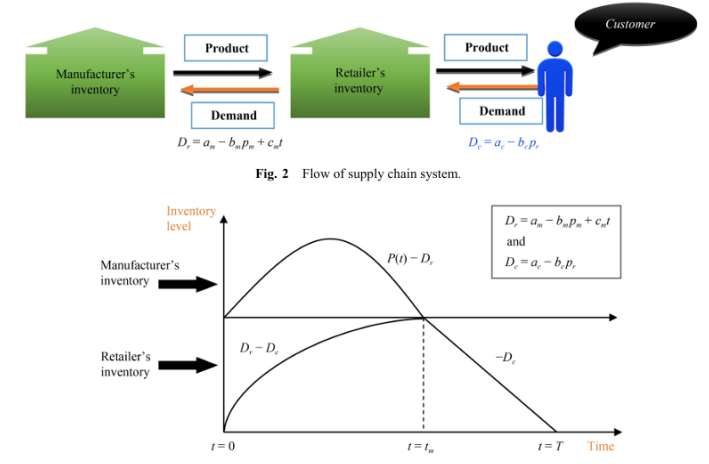
The study formulates a two-layer manufacturer–retailer supply chain model where market demand depends simultaneously on selling price and time. Production rate is defined as a control variable, and carbon emission is modeled as a linear function of production intensity—meaning higher production generates proportionally higher emissions. To solve the non-linear variational problem, the researchers applied optimal control theory and further evaluated decentralized scenarios using Stackelberg game analysis.
To obtain optimal decisions for production, pricing, inventory, and emission costs, six metaheuristic algorithms were tested and compared, including the Artificial Electric Field Algorithm, Firefly Algorithm, Grey Wolf Optimizer, Sparrow Search Algorithm, Whale Optimizer Algorithm, and the Equilibrium Optimizer Algorithm (EOA). The results show that EOA outperformed other algorithms in solution accuracy, convergence, and stability. Sensitivity analysis further demonstrates how variations in tax rate, production cost, or price elasticity influence profit and emission outcomes. These findings confirm that dynamic production control can reduce environmental impact while maintaining profitability—offering a more realistic strategy than models using fixed production assumptions.
"This model brings production planning closer to real industry conditions," the authors explain. "By treating production rate as a variable instead of a constant, we allow the system to react to demand and emission constraints over time. Through optimal control and algorithmic optimization, manufacturers can identify profitable operational levels without compromising environmental goals. Our comparative results prove that modern metaheuristic algorithms, especially EOA, hold great promise for solving large-scale supply chain problems."
This research provides a decision-support framework for industries operating under carbon regulation policies. It can guide manufacturers in adjusting production dynamically to balance cost, demand fluctuation, and emission targets. The model is applicable to sectors such as steel, cement, chemicals, consumer goods, and logistics—where carbon output scales directly with production intensity. With global emission taxes tightening, this approach may help companies develop greener strategies, lower penalties, and improve collaboration with retailers. Future work could incorporate stochastic events, renewable energy inputs, or multi-product chains to further enhance sustainability-driven supply chain design.
References
DOI
10.1007/s42524-025-4110-6
Original Source URL
https://doi.org/10.1007/s42524-025-4110-6
Funding Information
This research was supported by UGC SRF Fellowship (NTA Ref. Nos. 211610092425 and 201610165233).
About Journal
Frontiers of Engineering Management(FEM)
Chuanlink Innovations, where revolutionary ideas meet their true potential. Our name, rooted in the essence of transmission and connection, reflects our commitment to fostering innovation and facilitating the journey of ideas from inception to realization.
Related Link:
http://chuanlink-innovations.com
Read the full story here: https://www.24-7pressrelease.com/press-release/530201/adaptive-supply-chain-model-tackles-fluctuating-demand-and-emission-tax-pressure
Press Release Service and Press Release Distribution by 24-7 Press Release Newswire
Adaptive supply chain model tackles fluctuating demand and emission tax pressure
24-7 Press Release Newswire